


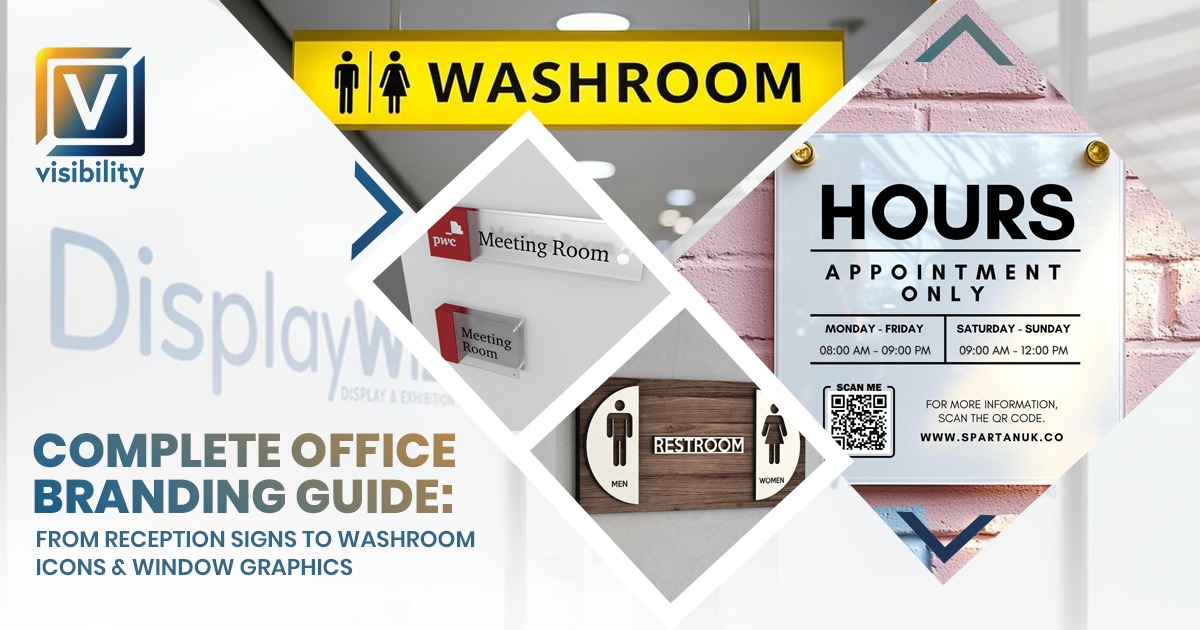
Complete Office Branding Guide: From Reception Signs to Washroom Icons & Window Graphics
An office is not just a place where your team works—it is a physical extension of your brand.
Every person who walks into your office, whether a client, partner, or employee, forms an opinion within seconds. And that opinion is not based on your services alone—it is based on what they see, feel, and experience inside your space.
This is where most businesses fall short.
They focus on one or two elements—like a logo sign at reception—but ignore the rest of the office. The result is a space that feels incomplete, inconsistent, and unprofessional.
Complete office branding solves this problem by ensuring every visual element—from reception signage to washroom icons—works together as one system.
Why Office Branding Matters More Than Ever
Today’s business environment is highly competitive. Clients have options, and they make decisions quickly.
When someone enters your office, they subconsciously evaluate:
- Is this company professional?
- Does this business look organized?
- Can I trust them?
These judgments are formed within seconds—and they are heavily influenced by your office environment.
A well-branded office communicates:
✔ Structure
✔ Clarity
✔ Attention to detail
✔ Professionalism
On the other hand, poor or incomplete branding creates confusion and doubt.
For employees, branding also plays a major role. A thoughtfully designed office improves:
- Motivation
- Engagement
- Sense of belonging
In simple terms, office branding is not decoration—it is a business tool that influences perception and behavior.
Also Read:
From Empty Walls to Fully Branded Store: Complete Signage Solutions for Retail Businesses in Utah
What Is Complete Office Branding?
Complete office branding means designing your office as a connected visual system, not as separate elements.
Instead of adding random signs or graphics, every part of the office is planned with a purpose.
This includes:
- Reception signage
- Directional signage
- Door plates
- Wall graphics
- Window graphics
- Glass branding
- Washroom and compliance signage
Why This Approach Matters
When these elements are designed separately:
- Styles don’t match
- Messaging feels inconsistent
- The office looks fragmented
When designed together:
- Everything feels aligned
- The space looks intentional
- The brand becomes stronger
This is what turns a normal office into a professional brand environment.
Reception Signage: Creating a Powerful First Impression
Your reception area is the most important branding zone in your office.
It is the first thing people see—and often the moment they decide how seriously to take your business.
Why Reception Signage Is Critical
A strong reception sign does more than display your logo.
It:
- Introduces your brand instantly
- Builds trust before conversation
- Sets the visual tone for the entire office
If your reception looks weak or unplanned, it creates doubt immediately.
Types of Reception Signs
Different materials and styles create different impressions:
- Acrylic signs → Clean and modern
- 3D lettering → Premium and bold
- LED backlit signs → High visibility and impact
- Metal finishes → Corporate and high-end
Best Practices
- Keep the design simple and readable
- Use proper lighting to highlight the sign
- Align colors with your brand
- Position at eye level for maximum visibility
A strong reception sign is not optional—it is your first branding statement.
Directional Signage: Making Your Office Easy to Navigate
Once someone enters your office, they should not feel lost.
Directional signage ensures that movement inside your office is smooth and intuitive.
Why Directional Signage Is Important
Without it:
- Visitors feel confused
- Employees waste time guiding people
- The office feels disorganized
With it:
- Movement becomes effortless
- The space feels structured
- User experience improves instantly
What Directional Signage Includes
- Arrows and wayfinding signs
- Department indicators
- Floor directories
- Section labels
How It Improves Experience
Good directional signage acts like a silent guide.
Visitors can:
- Find meeting rooms easily
- Navigate without asking questions
- Feel more comfortable in the space
This reduces friction and improves overall perception.
Door Plates: Adding Structure and Professional Detail
Door plates may seem small, but they play a huge role in office organization.
Every office, meeting room, and department relies on clear identification.
Why Door Plates Matter
Without proper door plates:
- Spaces feel undefined
- The office looks inconsistent
- Visitors get confused
With proper door plates:
- Everything is clearly labeled
- The office looks structured
- The environment feels professional
Types of Door Plates
- Acrylic nameplates
- Metal engraved plates
- Slide-in modular systems
- Magnetic or replaceable plates
Design Guidelines
- Use consistent fonts and sizes
- Match brand colors
- Ensure high readability
- Keep layouts clean and minimal
Door plates are small—but they add a layer of precision and professionalism.
Also Read:
From Empty Space to Strong Brand: How Complete Signage Transforms Utah Retail Stores
Wall Graphics: Turning Walls into Communication Tools
Walls are one of the largest visual surfaces in your office—and also one of the most underutilized.
Leaving them blank is not just a design gap—it’s a missed branding opportunity. Every empty wall is space that could be reinforcing your identity, guiding your team, or influencing how clients perceive your business.
What Wall Graphics Do
Wall graphics are not just decorative elements—they are strategic communication tools.
When designed properly, they allow your office to “speak” without anyone saying a word.
They can:
- Tell your brand story
A well-designed wall can communicate your journey, values, or what makes your company unique. This helps visitors instantly understand who you are. - Share your mission and values
Instead of keeping your mission hidden in documents, wall graphics make it visible and part of the daily environment. - Motivate employees
Thoughtfully placed messaging can influence mindset, productivity, and workplace culture. - Create visual interest
They break monotony and make your office feel modern, dynamic, and engaging.
In short, wall graphics turn passive space into active brand communication.
Types of Wall Graphics
Different types of wall graphics serve different purposes. Choosing the right type depends on your goals.
- Logo feature walls
Usually placed in reception or central areas, these reinforce brand identity and create a strong first impression. - Brand storytelling visuals
These can include timelines, achievements, or company history, helping build trust and credibility. - Motivational quotes
Ideal for workspaces, these influence employee mindset and reinforce company culture. - Custom illustrations or patterns
These add personality and uniqueness, making your office visually distinctive.
Why They Matter
Without wall graphics:
- The office feels empty and unfinished
- Branding feels weak or invisible
- The environment lacks energy and personality
With wall graphics:
- The space feels complete and intentional
- Your brand becomes visible at every touchpoint
- The office becomes memorable for visitors and clients
The key is balance—not filling every wall, but designing each wall with a clear purpose. Good wall graphics are not about quantity—they are about strategic placement and meaningful design.
Window Graphics: Making Use of Glass Surfaces
Modern offices rely heavily on glass—for openness, light, and space efficiency.
But most businesses leave glass completely unused, turning it into a wasted branding opportunity.
Window graphics allow you to convert glass surfaces into functional, aesthetic, and branding assets.
What Window Graphics Achieve
Window graphics provide both visual and practical benefits:
- Add privacy without blocking light
Frosted or patterned films allow light to pass through while maintaining privacy in meeting rooms or cabins. - Display branding elements
Logos, patterns, or subtle designs reinforce your identity across the office. - Improve aesthetics
Plain glass can feel cold or empty—graphics make it visually engaging. - Create visual consistency
When aligned with wall graphics and signage, they help maintain a unified look.
Types of Window Graphics
Each type serves a different purpose:
- Frosted vinyl
Ideal for privacy and a clean, professional appearance. - Printed designs
Great for adding color, branding, or storytelling elements. - Cut vinyl lettering
Perfect for minimal, clean branding like logos or text. - Decorative patterns
Used to add style while maintaining transparency.
Where to Use Them
Window graphics are most effective in:
- Meeting rooms (privacy + branding)
- Glass partitions (consistency across space)
- Entry doors (first impression + identity)
Why They Matter
Without window graphics, glass looks plain and disconnected from your brand.
With them, your office gains:
- Better functionality
- Stronger branding
- Improved visual flow
They help you achieve a perfect balance between openness and identity.
Glass Branding: Combining Function with Identity
Glass branding is a more advanced and intentional use of window graphics.
Instead of just adding design, it integrates branding into the structure of your office.
Why Glass Branding Is Important
Glass branding plays a critical role in modern office environments:
- Maintains openness while adding identity
You keep the transparent, spacious feel while still reinforcing your brand. - Enhances professionalism
Branded glass makes meeting rooms and cabins look premium and well-designed. - Creates visual consistency
Repeating patterns or branding elements across glass surfaces connects different areas of the office.
Best Applications
Glass branding works best in:
- Conference rooms (privacy + professionalism)
- Executive cabins (premium branding)
- Open workspaces (subtle visual structure)
Strategic Advantage
Glass branding is not just about design—it’s about experience.
It ensures that even functional elements like partitions contribute to your brand, making your office feel cohesive and thoughtfully designed.
Washroom & Compliance Signage: Small Details That Matter
These are often the most overlooked elements in office branding—but they play a critical role in user experience.
Ignoring them creates inconsistency. Handling them properly completes your branding system.
Why These Signs Are Important
- Help visitors find essential areas quickly
No one should have to ask where the washroom is. - Ensure accessibility compliance
Proper signage supports inclusivity and meets regulations. - Reflect attention to detail
Small details show how seriously you take your business environment.
Types of Signs
- Washroom icons (male, female, accessible)
- Accessibility signage (ADA-compliant where required)
- Emergency exit signs
- Safety and instruction signage
Best Practices
- Use clear, universally recognized icons
- Maintain the same design style as your branding
- Place signs at visible and logical locations
- Ensure readability from a distance
Why It Matters
Even though these are small elements, they influence perception.
A well-branded office pays attention to every detail—not just the obvious ones.
Also Read:
Planning an Office Renovation? Here’s How to Handle Glass Branding, Wall Graphics & Signage Together
The Power of Consistency Across the Office
Consistency is what transforms individual elements into a complete branding system.
Without it, even good design looks disconnected.
What Consistency Achieves
When all elements follow the same design language:
- The office feels intentional and well-planned
- Branding becomes stronger and more recognizable
- Clients and visitors feel more confident
What Happens Without Consistency
- The space feels fragmented
- Branding appears weak or confusing
- The office lacks a professional finish
Key Areas of Consistency
- Colors
- Typography
- Materials
- Design style
Consistency is what turns design into brand identity.
Planning Your Office Branding the Right Way
A successful office branding project always starts with planning.
Without a clear strategy, results become inconsistent.
1. Define Brand Identity
Start by establishing:
- Brand colors
- Fonts
- Tone and visual style
This becomes the foundation for all design decisions.
2. Analyze Layout
Understand how people move through your office:
- Entry points
- High-traffic areas
- Key interaction zones
This helps you place branding elements effectively.
3. Assign Purpose
Every element should have a role:
- Reception → First impression
- Signage → Navigation
- Walls → Branding and storytelling
- Glass → Function + visual identity
4. Maintain Consistency
Ensure all elements follow the same visual system.
This is what creates a professional, unified environment.
5. Use Quality Materials
Investing in quality ensures:
- Long-lasting appearance
- Resistance to wear and fading
- Better overall perception
Cheap materials can damage your brand image over time.
Final Thought
Complete office branding is not about adding more—it’s about connecting everything.
From reception signs to washroom icons, every detail contributes to how your business is perceived.
When everything works together, your office becomes:
- Easy to navigate
- Visually engaging
- Professionally structured
- Memorable
And most importantly—it becomes a true reflection of your brand.
Because in today’s business world, your office is not just a workplace—it’s your brand in physical form.
Back