


The Complete Guide to Sign design installation repair Utah
I got a call last year from a restaurant owner in Provo who was frustrated. He’d ordered a sign online from an out-of-state vendor — designed it himself using a template, paid for shipping, and hired a local handyman to bolt it to the building. Six months later, the colors had faded noticeably, one corner had pulled away from the mounting surface during a windstorm, and the illumination was flickering because the wiring wasn’t weatherproofed properly. He’d spent a decent amount of money and ended up with a sign that was actively making his business look worse than having no sign at all.
When he came to us at Visibility Signs & Graphics, we didn’t just replace the sign. We started from scratch — site evaluation, professional design aligned with his brand, proper material selection for his specific building and exposure, engineered fabrication, permitted installation, and a maintenance plan to protect the investment going forward. Eight months later, that sign still looks exactly like the day we installed it.
That experience captures everything this guide is about. Sign design, installation, and repair aren’t three separate things — they’re three phases of a single process, and the quality of each phase directly affects the others. Cut corners on design and the fabrication suffers. Cheap out on installation and even a beautiful sign falls apart. Ignore maintenance and your investment deteriorates in plain sight.
Here’s what Utah business owners need to understand about each phase — and how getting them right transforms signage from an expense into a genuine business asset.
Phase One: Sign Design — Where Strategy Meets Creativity
Most people think sign design starts with choosing colors and fonts. It doesn’t. It starts with questions. Who is your audience? Where will this sign be viewed from? How fast is the traffic passing it? What’s the primary action you want a viewer to take? What does your competitive environment look like — what signs surround yours and how do you differentiate?
These strategic questions shape every visual decision that follows. And skipping them is the single biggest reason businesses end up with signs that look fine on a computer screen but fail completely in the real world.
Readability Is Non-Negotiable
Here’s a rule I apply to every sign design we create: if it can’t be read in the actual viewing conditions at the actual installation site, nothing else about the design matters. Not the colors. Not the creativity. Not the logo. None of it.
Readability is a function of letter height, font weight, color contrast, and viewing distance. For a sign facing a road with 40 mph traffic, letters need to be significantly larger than for a sign facing a pedestrian walkway. Thin, decorative script fonts that look elegant in a logo might be completely illegible from 100 feet away at driving speed. High contrast — dark letters on a light background or light letters on a dark background — is always more readable than low-contrast combinations, regardless of how aesthetically pleasing the muted palette looks in a mockup.
I’ve had clients push back on these principles because they wanted a specific “look.” I always show them a scaled simulation of their sign at actual viewing distance before making final decisions. Nine times out of ten, they see it and immediately agree that readability should win. That simulation step is part of every design engagement at Visibility Signs & Graphics because real-world performance beats theoretical aesthetics every time.
Brand Alignment Goes Deeper Than Logo Placement
Your sign doesn’t just display your brand — it embodies it. The material choice, the lighting style, the mounting method, the proportions, the finish — all of these communicate something about who you are as a business before anyone reads a single word.
A brushed aluminum panel with clean sans-serif typography says “modern, precise, professional.” A carved wood sign with warm lighting says “artisan, welcoming, established.” A bold LED-illuminated cabinet sign says “accessible, high-energy, commercial.” None of these are right or wrong in isolation — they’re right or wrong relative to your specific brand and audience.
This is where working with designers who understand both visual communication and signage fabrication becomes critical. A graphic designer who’s never built a sign might create something gorgeous that can’t be manufactured. A fabricator who doesn’t understand branding might build something durable that sends the wrong message. At Visibility Signs & Graphics, our design team and production team collaborate from the very first concept sketch, ensuring that every design we present is both brand-aligned and physically buildable.
Material Selection Starts During Design, Not After
I can’t emphasize this enough: the material your sign is made from should be determined during the design phase, not treated as an afterthought during fabrication. Material choice affects the visual aesthetic, structural requirements, illumination options, weather durability, and total project cost. Designing a sign without knowing the material is like designing a house without knowing whether it’s wood-frame or steel construction — the details change everything.
For outdoor applications in Utah, material durability is a primary concern. Aluminum, ACM (aluminum composite material), high-impact acrylic, and marine-grade PVC are all viable options depending on the application. For indoor applications, the material palette opens wider — acrylic, wood, metal, fabric, vinyl, and combination builds all have their place.
Certain sign types have inherent material requirements. Pylon signs — those tall, freestanding pole signs you see along highways and major commercial corridors — require engineered steel or aluminum pole structures rated for wind loads specific to their installation location. Cabinet signs use aluminum frames with polycarbonate or acrylic faces. Digital signs require weather-rated enclosures with proper ventilation for the electronic components.
Understanding these material-format relationships during design prevents costly revisions later and ensures the final product performs as intended.
Phase Two: Sign Installation — Where Precision Meets Engineering
I’ve seen enough botched sign installations to fill a horror reel. Crooked channel letters with visibly uneven spacing. Monument signs that lean because the foundation wasn’t properly set. Electrical connections that shorted out after the first rain because nobody sealed the conduit penetrations. Hanging signs that dropped because the anchor hardware wasn’t rated for the weight plus wind load.
Every one of those failures happened because installation was treated as an unskilled labor task instead of the technical discipline it actually is. Professional sign installation requires knowledge of structural engineering principles, electrical codes, building materials, local permitting requirements, and weather-specific considerations. In Utah, all of those factors come with regional specifics that out-of-state vendors and general contractors typically don’t account for.
Structural Mounting Varies by Building Type
The Wasatch Front has an enormous diversity of commercial building construction: steel-frame with EIFS cladding, tilt-up concrete, brick and mortar, wood-frame with stucco, glass curtain walls, metal panel systems, and more. Each substrate requires different anchoring methods, different hardware, and different load calculations.
Mounting channel letters on a concrete block wall is a completely different process than mounting them on a metal stud wall with synthetic stucco cladding. The concrete wall can accept expansion anchors directly. The stud wall requires backing plates or through-bolts engineered to distribute the load across the structural framing. Using the wrong method for the substrate risks both sign failure and building damage.
Our installation crews at Visibility Signs & Graphics assess the mounting surface during the site evaluation phase — before design is finalized — specifically so we can engineer the mounting approach into the project plan. There are no surprises on installation day because we’ve already solved the structural questions weeks earlier.
Electrical Work Requires Licensed Expertise
Any illuminated sign — channel letters, cabinet signs, digital signs, LED-backlit panels — involves electrical connections that must meet both the National Electrical Code and local Utah building codes. In most municipalities across Central and Northern Utah, sign electrical work requires permits and inspections. Some cities require the work to be performed by or supervised by a licensed electrician.
Improper electrical installation doesn’t just risk code violations and failed inspections — it creates genuine safety hazards. Water intrusion into poorly sealed junction boxes. Overloaded circuits from incorrectly specified transformers or drivers. Exposed wiring in accessible locations. These aren’t hypothetical risks. We’ve encountered all of them on repair calls for signs originally installed by unqualified parties.
At Visibility Signs & Graphics, our installation teams handle all electrical aspects of sign installation in compliance with applicable codes, and we coordinate permit applications and inspections as a standard part of our project management process.
Permitting Is Part of Installation, Not an Optional Add-On
Every city in Utah has sign ordinances governing what types of signs can be installed, where they can be placed, how large they can be, how they can be illuminated, and what permitting process must be followed. Provo’s sign code differs from Orem’s. Salt Lake City has different requirements than Sandy or Lehi. Pleasant Grove, American Fork, Lindon, Springville — each municipality maintains its own set of rules.
Ignoring these codes doesn’t just risk fines. It can result in a forced removal of your sign — meaning you’ve paid for design, fabrication, and installation of a sign that you’re legally required to take down. That’s a total loss.
We handle permitting as a routine part of every installation project. We know which cities require sign permits, what documentation they need, what the typical review timelines look like, and how to design within code parameters from the start. For business owners, this means one less thing to worry about — and zero risk of compliance surprises.
Specialty Installation Scenarios
Some sign installations go beyond standard wall-mounting or ground-mounting and require specialized approaches:
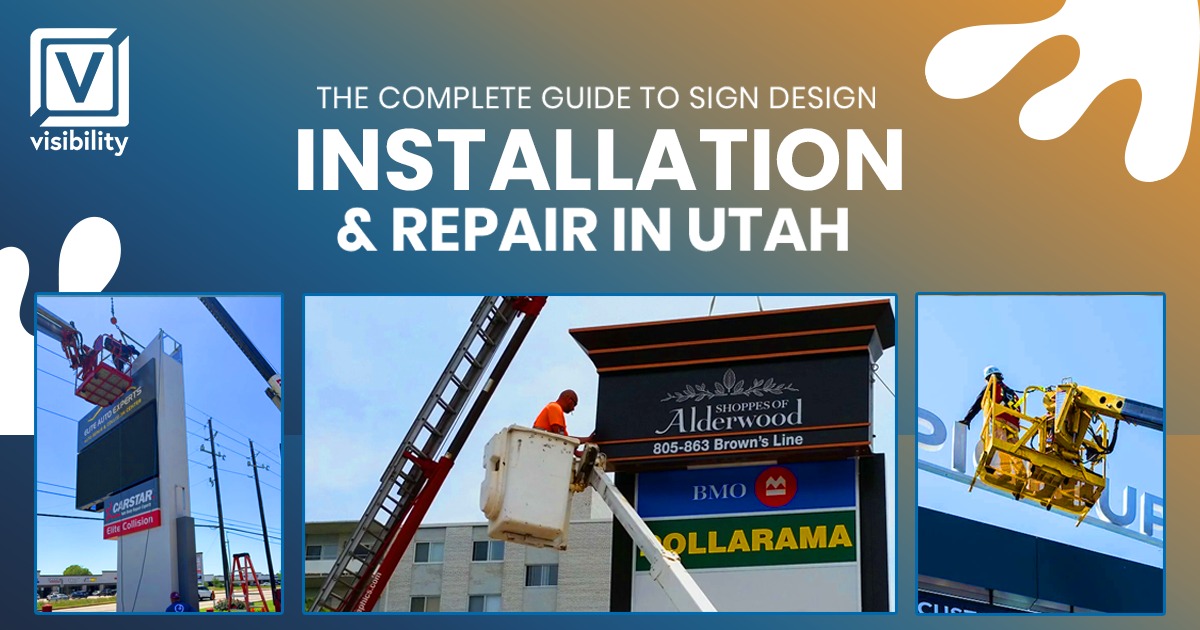
Pylon signs involve excavation, concrete foundation pouring, steel pole erection, and often crane-assisted sign cabinet placement at height. These are engineered structures that must be designed to withstand specific wind loads based on the sign’s height, area, and geographic location. Utah’s wind exposure — particularly along bench areas and canyon corridors — can be severe, and pylon sign engineering must account for that.
Hanging signs — suspended from ceilings, canopies, or architectural overhangs — require overhead anchor points rated for both the static weight of the sign and dynamic forces from vibration or air movement. In retail environments and office lobbies, ceiling-mounted signs need to integrate cleanly with existing ceiling systems without compromising fire suppression, HVAC, or lighting infrastructure.
Elevator graphics and ceiling graphics in interior environments require coordination with building management, access to above-ceiling infrastructure for mounting hardware, and careful surface preparation to ensure adhesion longevity. We’ve installed elevator graphics in office buildings and medical facilities that transform otherwise bland elevator interiors into branded experiences — but only because the surface preparation and material selection were done correctly.
Door signs — whether mounted on glass, wood, or metal doors — need hardware and adhesive systems that account for the door’s constant movement. A sign mounted rigidly to a door that flexes during opening and closing will eventually crack, separate, or damage the door surface. We specify appropriate mounting methods based on door material and usage patterns.
Each of these scenarios requires specific expertise that generalist contractors simply don’t have. That’s not a criticism — it’s a specialization reality. You wouldn’t ask your dentist to do your taxes.
Phase Three: Sign Repair and Maintenance — Protecting Your Investment
Here’s an uncomfortable truth that most sign companies prefer not to discuss: every sign ever made will eventually need maintenance or repair. No material is indestructible. No LED module lasts forever. No paint or vinyl is completely immune to UV degradation over many years. Weather events, vehicle impacts, vandalism, and simple age all take their toll.
The question isn’t whether your sign will need attention — it’s whether you’ll address it proactively or let it deteriorate until it’s hurting your brand.
What Deterioration Actually Looks Like
Drive through any commercial corridor in Utah and you’ll spot signs in various stages of neglect:
Illumination failures. Individual LEDs or sections burning out, creating dark spots in channel letters or uneven lighting across cabinet sign faces. A sign that reads “OPEN” with the “O” burned out sends a very specific (and unflattering) message about your business.
Color fading. UV exposure gradually bleaches printed vinyl graphics and painted surfaces, especially south-facing and west-facing signs that take the most direct sun. What started as vibrant brand colors slowly shifts toward a washed-out, neglected appearance.
Structural damage. Wind, snow loads, vehicle impacts, and settlement can cause signs to lean, crack, separate from mounting surfaces, or lose structural components. A hanging sign that’s visibly askew or a monument sign with a cracked face panel communicates neglect whether you intend it to or not.
Surface deterioration. Acrylic faces yellow over time with UV exposure. Painted aluminum can develop oxidation spots if the paint film is compromised. Wood signs crack, split, and rot without regular sealing treatment. Vinyl wraps on sign faces can bubble, peel, or crack as adhesive ages.
Electrical issues. Corroded connections, water-damaged transformers, failing LED drivers, or damaged wiring can cause intermittent lighting, flickering, or complete electrical failure. These issues can also create safety hazards if left unaddressed.
Proactive Maintenance vs. Reactive Repair
There are two approaches to sign upkeep, and the cost difference between them is dramatic.
Proactive maintenance means scheduled inspections and cleaning — typically annually or semi-annually — that catch small issues before they become big problems. Tightening a loose fastener is a ten-minute task. Replacing that fastener after the sign has partially separated from the building is a half-day job requiring a lift truck. Replacing a single failing LED module costs a fraction of what it costs to re-lamp an entire channel letter set after years of neglect have caused cascading module failures.
Reactive repair means waiting until something is visibly broken or completely failed and then calling for emergency service. This approach almost always costs more because the damage has had time to compound, access is often more urgent (and therefore more expensive to arrange), and the repair scope is larger than it would have been with earlier intervention.
At Visibility Signs & Graphics, we offer both scheduled maintenance programs and responsive repair services. Our maintenance clients consistently spend less on their signage over time than businesses that wait for failures — and their signs look better every day in between.
When Repair Makes Sense vs. When Replacement Is Smarter
Not every damaged or deteriorated sign should be repaired. Sometimes the most cost-effective decision is replacement rather than repeated repair of an aging sign.
Here’s the general framework I use when advising clients:
Repair makes sense when the sign’s underlying structure is sound, the design is still current and brand-aligned, and the issue is isolated (a lighting component, a vinyl panel, a single damaged letter, a mounting bracket). In these cases, targeted repair restores the sign to full function at a fraction of replacement cost.
Replacement makes sense when the sign has multiple simultaneous issues, the structure itself is compromised, the design is outdated relative to your current brand, the sign technology is obsolete (old neon or fluorescent systems where parts are increasingly difficult to source), or code changes mean the existing sign is no longer compliant.
A medical office in Murray came to us with a fluorescent-lit cabinet sign that needed a ballast replacement — the fourth in three years. Each repair was individually affordable, but the cumulative cost was approaching what a new LED-illuminated sign would cost. We recommended replacement with a modern LED cabinet sign that would eliminate the recurring ballast failures entirely. Two years later, zero repair calls. The math was simple.
We never push replacement when repair is the smarter financial decision, and we never band-aid a sign that genuinely needs to be replaced. Honest assessment is part of what we do.
Also Read:
Complete Office Branding Guide: From Reception Signs to Washroom Icons & Window Graphics
Pulling It All Together: The Full-Service Advantage
The thread connecting design, installation, and repair is continuity. When one company handles all three phases, every decision is informed by what came before and what comes after.
Our designers specify materials and construction methods that our fabricators know how to build and our installers know how to mount. Our installers document every mounting point, electrical connection, and access method so that our maintenance team can service the sign efficiently for years to come. Our repair technicians feed real-world performance data back to our design team so that future projects benefit from lessons learned.
That feedback loop doesn’t exist when you use three different vendors for three different phases. The designer doesn’t know how the fabricator interpreted their files. The fabricator doesn’t know how the installer mounted the product. The repair technician has no documentation of what’s behind the sign face or inside the wall. Every hand-off is a potential failure point.
At Visibility Signs & Graphics, we eliminate those hand-offs. One team. One relationship. One accountability chain from first concept through decade-long maintenance. That’s what full-service sign services actually means in practice — and it’s why our clients’ signs consistently look better, last longer, and cost less to maintain than signs pieced together across multiple vendors.
Choosing What’s Right for Your Business
If you’re a business owner in Utah staring at a sign that’s faded, dark, damaged, or just doesn’t represent who you are anymore — you’re not stuck with it. And if you’re launching a new business or expanding to a new location, you have the opportunity to get it right from day one.
Start with the right questions: What do I want this sign to accomplish? Who needs to see it and from where? What does my brand need to communicate at this specific location? How long do I need this sign to last? What’s my realistic budget for both initial investment and ongoing maintenance?
Then find a sign partner who can help you answer those questions honestly and execute the solution professionally — from sign design through sign installation through years of reliable performance.
At Visibility Signs & Graphics, we serve businesses across Central and Northern Utah — from Provo, Orem, and Lehi through Salt Lake City, Sandy, Park City, Layton, Bountiful, and every community in between. Whether you need a brand-new signage package, a repair on existing signs, or a straight conversation about what your current signage is costing you in missed opportunities, we’re here for it.
Reach out to our team and let’s figure out what your business needs. Because the right sign, installed right, and maintained right, is one of the few business investments that works for you every single hour of every single day — without ever asking for a raise.
Back