


The Power of Temporary Signs in Northern and Central Utah: Boosting Brand Visibility
Last spring, a new smoothie bar was getting ready to open in a retail center in Orem. Their permanent channel letters were still three weeks out from installation. Their window vinyl hadn’t been scheduled yet. The lease was signed, the equipment was in, the staff was trained — but from the street, the unit looked empty. No name. No brand presence. Nothing telling the thousands of cars driving past every day that something new and exciting was about to open.
We got the call on a Tuesday. By Thursday, we had two temporary signs installed — a large vinyl banner across the facade reading “Grand Opening This Saturday” and a set of yard signs placed at the parking lot entrance and along the adjacent sidewalk. That Saturday, there was a line out the door before they even flipped the open sign. Three weeks later, when the permanent signage went up, the business already had a steady customer base. Those temporary signs bridged a gap that could have cost them thousands in lost momentum.
That’s what temporary signs do when they’re used strategically. They’re not lesser signage. They’re not the budget option you settle for when you can’t afford the real thing. Temporary signs are a distinct category of marketing tool designed for speed, flexibility, and targeted impact — and in Northern and Central Utah’s fast-moving business environment, they’re indispensable.
At Visibility Signs & Graphics, we produce temporary signage for businesses across the Wasatch Front every single week. Here’s why they work so well and how to use them for maximum return.
Speed Is the Superpower of Temporary Signs
Let me start with the benefit that matters most in real business scenarios: turnaround time.
Permanent signage — channel letters, monument signs, dimensional logos — involves design, fabrication, permitting, and scheduled installation. That process can take anywhere from three to eight weeks depending on complexity and municipal review timelines. That’s fine for long-term branding. But business doesn’t always operate on an eight-week timeline.
Promotions come together quickly. Events get confirmed with two weeks’ notice. Seasonal opportunities appear and disappear within a narrow window. A competitor opens nearby and you need to remind the neighborhood you exist. A new service launches and you need to announce it before the marketing window closes.
Temporary signs meet those moments. From approved design to finished product, most temporary sign formats can be produced in days — sometimes same-week, sometimes next-day depending on the format and quantity. That speed is what makes them so valuable as a tactical marketing tool.
A tax preparation office in Sandy calls us every January for the same order: sidewalk signs for the street corner, a banner for their building facade, and yard signs for key intersections within a two-mile radius. By January 15th, they’re blanketing their service area with visibility. By April 16th, the signs come down. They’ve done this every year for the past four years, and every year the owner tells us that the first two weeks of sign deployment coincide with their biggest spike in new client bookings. That’s not coincidence. That’s temporary signage doing exactly what it’s designed to do — delivering targeted visibility on a defined timeline.
The Format Options Are More Diverse Than Most People Think
When business owners hear “temporary signs,” most picture a basic corrugated plastic sign stuck in the ground. And while corrugated signs are absolutely part of the temporary signage arsenal — and a very effective part — the category is much broader than that single format.
Here’s what we produce regularly at Visibility Signs & Graphics for temporary applications:
Yard signs are the classic temporary format. Corrugated plastic panels (usually 4mm or 6mm fluted polypropylene) printed with full-color graphics and mounted on wire H-stakes or step stakes. They’re lightweight, inexpensive, weather-resistant for short-to-medium-term outdoor use, and can be deployed in minutes. We produce these for grand openings, directional wayfinding, real estate, political campaigns, event promotion, and seasonal sales.
Corrugated signs in larger formats go beyond the standard yard sign size. We fabricate corrugated panels in custom dimensions for construction site signage, development project announcements, and temporary property identification. A development company in Lehi ordered a set of 4×8-foot corrugated signs for a new subdivision entrance — they needed to announce lot availability while the permanent monument sign was still being designed and permitted. The corrugated signs held up through three months of spring weather and served their purpose perfectly.
Sidewalk signs — also known as sandwich boards — sit on the ground near your entrance or on the sidewalk in front of your business. They’re a direct invitation to foot traffic. Restaurants, salons, boutiques, and service businesses across Provo and Orem use sidewalk signs daily to promote specials, announce events, or simply remind passersby that they’re open. The best sidewalk signs use bold, simple messaging that can be read in a quick glance from fifteen to twenty feet away.
Flag signs — also called feather flags or flutter flags — are vertical banners mounted on flexible poles that create movement. Movement attracts the eye, and in a streetscape full of static signs, a flag sign waving in the breeze stands out immediately. We produce these for car dealerships, fitness studios, retail stores, seasonal businesses, and event venues. They set up in minutes, break down just as fast, and can be repositioned wherever you need attention directed.
Retractable banners are the go-to temporary sign for indoor events, trade shows, open houses, presentations, and lobby displays. The banner rolls up into a compact base unit, and the whole assembly fits in a carrying case. Set up takes about thirty seconds. We produce retractable banners for businesses that attend regular networking events, health fairs, job fairs, and community expos across Northern and Central Utah. They look polished, they travel easily, and they give you a professional branded presence in any indoor setting.
Portable signs encompass a broader range of freestanding temporary displays — from weighted base signs used in parking lots to pop-up frames used at outdoor festivals. Their defining characteristic is that they don’t require permanent mounting or installation. You place them, they do their job, and you move them when you’re done.
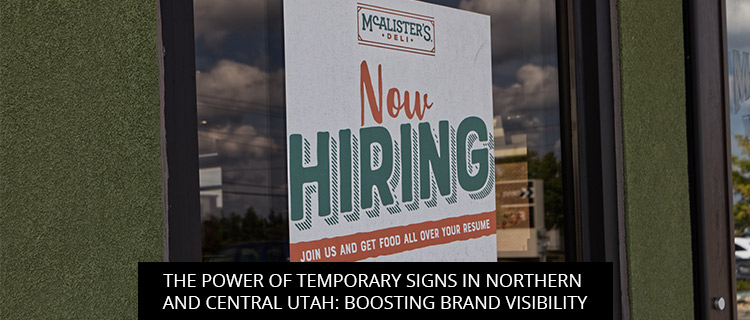
Window signs applied with temporary adhesive or static cling material let you transform your storefront glass into a promotional surface without any permanent modification. Seasonal sale announcements, hiring notices, new service launches — window signs handle all of these with clean application and easy removal. A boutique in Springville changes their window signs monthly to highlight different product lines, keeping their storefront looking fresh and giving repeat passersby a reason to glance over every time.
The point is that “temporary” doesn’t mean “one size fits all.” The right format depends on where the sign will be displayed, how long it needs to last, who the audience is, and what action you want them to take.
Strategic Placement Is Where Temporary Signs Win or Lose
I’ve seen businesses order great-looking temporary signs and then place them where nobody sees them. Behind a bush. Facing the wrong traffic direction. Too far from the road to read. Tucked next to a column that blocks the sightline. A beautiful sign in a bad location is just wasted money.
Temporary signs succeed when placement is treated as carefully as design. And because temporary signs are movable, you have something that permanent signage doesn’t offer: the ability to test and adjust.
Here’s how I advise our clients to think about placement:
Identify the traffic flow you want to intercept. Is it vehicle traffic on the main road? Pedestrian foot traffic on the sidewalk? Customers already in a parking lot who need to find your specific unit? Each scenario requires a different sign format and position.
Consider viewing speed and distance. A yard sign near a road with a 40 mph speed limit needs larger text and simpler messaging than a sidewalk sign targeting pedestrians walking at 3 mph. If someone can’t read your sign at the speed they’re traveling, the sign doesn’t exist for them.
Use multiple signs to create a funnel. This is a technique I recommend constantly because it works so well. Place a flag sign or yard sign at a high-visibility intersection to grab initial attention. Place a second sign at the parking lot entrance to confirm the turn. Place a third sign near your door to close the loop. Each sign in the sequence does one small job — attract, direct, confirm — and together they create a path that guides people directly to your business.
A martial arts studio in Kaysville used exactly this approach for a free trial event. They placed flag signs at two nearby intersections, yard signs at the strip mall entrance, and a sidewalk sign outside their door. Thirty-two people showed up for the trial event. The owner told us it was the highest attendance they’d ever had for a single promotion, and the only advertising was the temporary signs. Total investment: under $400.
Rotate placements to prevent “sign blindness.” If a temporary sign sits in the same spot for months, people stop noticing it. Moving it to a different position every few weeks — even a few feet in a different direction — resets the visual attention cycle. This is one of the major advantages temporary signs have over permanent signage.
Temporary Signs Fill Gaps That Permanent Signage Can’t
Every business has moments where their permanent signage doesn’t cover the messaging need. Temporary signs exist specifically for those gaps.
Pre-opening visibility. Your permanent sign isn’t installed yet, but you need people to know you’re coming. “Coming Soon” and “Grand Opening” temporary signs generate buzz and anticipation. I mentioned the smoothie bar example earlier — that scenario plays out with new businesses across Utah County and the Salt Lake Valley every month. The businesses that bridge the gap with temporary signs launch stronger than the ones that wait in silence for their permanent signage.
Seasonal and promotional campaigns. Your permanent sign says who you are. Temporary signs say what you’re doing right now. “Summer Sale — 30% Off.” “Now Hiring.” “Free Consultation This Week.” “Holiday Hours.” These messages change frequently, and modifying permanent signage for every campaign is impractical and expensive. Temporary signs handle it effortlessly.
Event marketing. Whether you’re hosting a customer appreciation day, sponsoring a community event, or exhibiting at a local fair, temporary signs carry your brand into environments your building sign can’t reach. A retractable banner at a networking lunch. Flag signs at a charity 5K. Yard signs directing attendees to your company picnic. These are the moments where temporary signage extends your brand presence beyond your physical location.
Construction and renovation periods. When your business is under construction or renovation, the disruption can kill foot traffic if people assume you’re closed. Temporary signs that say “Pardon Our Dust — Still Open!” or “Exciting Changes Coming — Open During Renovation” keep customers coming through the door during the transition. A restaurant in Murray kept two prominent banners up during a six-week kitchen renovation. Their staff told us multiple customers per day mentioned seeing the “Still Open” sign and deciding to stop in. Without those signs, those customers would have driven right past.
Directional and wayfinding needs for temporary situations. Special events, construction detours, parking changes, temporary entrances — all of these create navigation challenges that temporary directional signs solve. A medical office complex in Draper used temporary wayfinding signs during a parking lot repaving project to guide patients to alternate parking and a temporary entrance. Without those signs, the confusion would have driven patients to reschedule — or worse, switch providers.
Design Principles That Make Temporary Signs Actually Work
Because temporary signs are typically viewed quickly and from a distance, design discipline matters even more than with permanent signage. You have less real estate, less viewing time, and often more visual competition from the surrounding environment.
Here are the principles I apply to every temporary sign project:
One message per sign. Not two. Not three. One. The sign either announces something (“Grand Opening Saturday”), directs someone (“Turn Here →”), or promotes something (“50% Off This Week”). Trying to do all three on a single corrugated yard sign guarantees that nobody absorbs any of them.
Maximum contrast. Dark text on a light background or light text on a dark background. Every single time. I’ve seen pastel-on-pastel temporary signs that are literally invisible from more than ten feet away. High contrast isn’t a style choice for temporary signs — it’s a functional requirement.
Large, bold fonts. If someone squints to read your sign, you’ve lost them. The general rule I follow is one inch of letter height for every ten feet of viewing distance. A sign intended to be read from fifty feet needs letters at least five inches tall. Simple sans-serif fonts — not script, not decorative, not thin-weight — read fastest at distance and speed.
Your logo and brand colors. Even a temporary sign should be visually connected to your brand. When someone sees your temporary yard sign on the street and then encounters your permanent signage at your location, the color and logo recognition should create an immediate connection. Consistency compounds over time — even with short-term signage.
A clear call to action. Every temporary sign should tell the viewer what to do next. Visit this address. Call this number. Come this Saturday. Turn here now. Without a call to action, a temporary sign is just a notification. With one, it becomes a conversion tool.
At Visibility Signs & Graphics, we apply these principles to every temporary sign we produce — from a single yard sign to a hundred-piece deployment. Because even a $15 corrugated sign should be designed to actually work.
The Businesses Winning With Temporary Signs Right Now
Across Northern and Central Utah, the businesses getting the most from temporary signs share a common approach: they plan for them, they budget for them, and they use them consistently rather than as one-off panic buys.
Smart restaurants rotate window signs and sidewalk signs monthly to promote new menu items and seasonal specials. Growing service companies blanket their service area with branded yard signs after every completed job. Retail stores use flag signs to draw attention during sale events and swap them out between campaigns. Professional offices keep retractable banners on hand for every networking event and community expo they attend.
These businesses treat temporary signs as a permanent part of their marketing strategy — which is an irony that’s also exactly the point. The signs are temporary. The strategy is ongoing.
Put Temporary Signs to Work for Your Business
If you’re not currently using temporary signs as part of your marketing mix, you’re leaving visibility on the table. They’re fast to produce, affordable to deploy, flexible enough for any scenario, and effective when designed and placed with intention.
At Visibility Signs & Graphics, we help businesses across Northern and Central Utah — from Provo, Orem, and Lehi through Salt Lake City, Sandy, Kaysville, Bountiful, and everywhere in between — get the most out of every temporary sign investment. Whether you need a handful of yard signs for a weekend event or a full temporary signage package for a multi-week campaign, we’ll make sure every sign earns its place.
Reach out to our team and tell us what you’re working on. We’ll recommend the right formats, design them to perform, and get them in your hands fast. Because in business, timing matters — and temporary signs are built for exactly those moments when waiting isn’t an option.
Back