


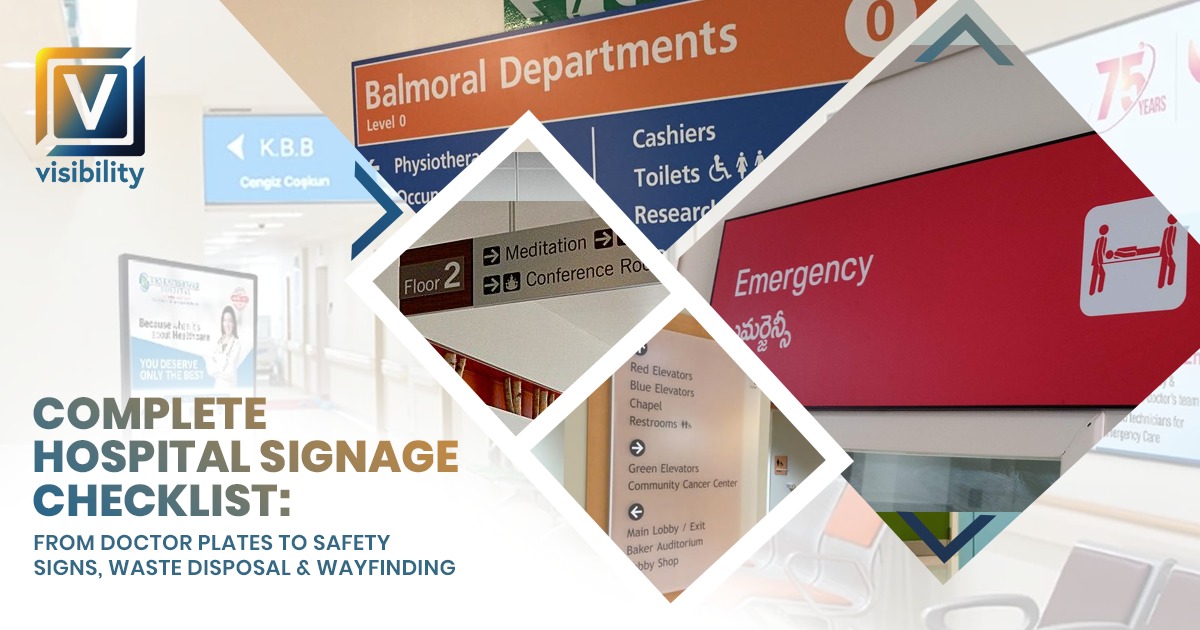
Complete Hospital Signage Checklist: From Doctor Plates to Safety Signs, Waste Disposal & Wayfinding
Introduction: Why Every Hospital Needs a Signage Checklist
Running a hospital is one of the most complex operational challenges in any industry. Dozens of departments, hundreds of staff members, thousands of patients and visitors moving through the building every single day — and every single one of them depending on your signage to get where they need to go safely.
Yet despite this complexity, most hospitals do not have a documented, comprehensive signage checklist. Signs get added reactively when a problem arises. A department moves, and the old directional sign stays on the wall for months. A new physician joins, and there is no consistent nameplate system to add their name to their door. A utility room gets a printed paper label taped to the door instead of a proper sign.
The result is a fragmented, inconsistent signage environment that confuses patients, frustrates staff, creates compliance risks, and communicates disorganization to everyone who walks through the door.
A complete hospital signage checklist solves all of that. It gives your facilities team, signage vendor, and compliance officer a single reference document that covers every sign type your facility needs — organized by location and function — so nothing is overlooked, nothing falls out of compliance, and your entire facility presents a consistent, professional, and navigable environment.
This guide is that checklist. We have organized it by zone and function, covering every sign category from exterior wayfinding and lobby directories to doctor nameplates, department identification, safety warning signs, waste disposal signs, and emergency exit systems. Use it as a reference for new builds, facility renovations, or a full signage audit of your existing Provo healthcare facility.
How to Use This Checklist
Before working through each category, take the following steps to get maximum value from this checklist:
- Conduct a walk-through of your facility with this checklist in hand, zone by zone
- Document the current state of each sign type — present and compliant, present but non-compliant, missing entirely
- Prioritize by risk — safety signs and ADA compliance gaps carry the highest liability and should be addressed first
- Assign ownership — identify who is responsible for each sign type, whether that is facilities management, department heads, or your signage vendor
- Set a review schedule — hospital signage should be audited every three to five years at minimum, and immediately after any renovation or departmental reorganization
Now let us walk through every zone, and every sign type your hospital needs.
Also Read:
Why Your Store Isn’t Attracting Customers (And How Outdoor & Indoor Signs Can Fix It Fast)
Section 1: Exterior and Campus Signage Checklist
The patient experience begins at the street. Before anyone enters your building, your exterior signage system must guide them from the road to the correct entrance without confusion or wrong turns.
Primary Identification Signs
- Main monument sign at the primary road entrance displaying the hospital name, logo, and any relevant campus identifier
- Secondary monument signs at additional campus entry points if your facility has multiple road access points
- Building identification signs mounted on the facade of each building on a multi-building campus — large enough to read from the parking lot
- Campus name signs at pedestrian entry points from adjacent streets or walkways
Parking and Traffic Directional Signs
- Visitor parking signs at every parking zone designated for patients and visitors
- Staff parking signs at every zone restricted to hospital employees
- Emergency drop-off zone signs clearly marking the patient set-down area adjacent to the main entrance
- Ambulance bay signs at the emergency department vehicle entrance
- Valet parking signs if applicable at your facility
- Parking structure level identification signs inside multi-story parking garages — floor numbers, color codes, and directional arrows to exits and elevators
- Accessible parking signs with ADA-compliant blue and white format at every designated accessible parking space
Entrance Identification Signs
- Main entrance signs clearly distinguishing the primary patient and visitor entry from other entrances
- Emergency department entrance signs — illuminated, high-visibility, with a distinctive color code (typically red) visible day and night from all approach directions
- Outpatient clinic entrance signs if your facility has a separate entrance for scheduled outpatient appointments
- Staff entrance signs at employee-only entry points
- Delivery and service entrance signs at loading docks and vendor access points
- Accessible entrance signs identifying all entrances with step-free access, automatic doors, and wheelchair accessibility
After-Hours and Illumination
- After-hours entry signs directing patients and visitors to the correct entrance when the main entrance is closed
- Illuminated exterior signs — confirm all exterior directional and identification signs are properly lit and functioning after dark
Section 2: Lobby and Reception Area Signage Checklist
The lobby is the most critical interior navigation zone in any hospital. Every patient passes through it, and it sets the tone for the entire visit.
Building Directory Signs
- Main lobby directory listing all departments, floors, key services, and their locations — organized logically and easy to scan within thirty seconds
- Department floor listing showing which floor each major service occupies
- Building map or floor plan in a format patients can reference before proceeding to elevators or corridors
Reception and Check-In Signs
- Reception desk identification sign — hospital name or department name in dimensional letters or channel letters mounted on or above the reception desk
- Check-in signs at each check-in window or station identifying the function of that station
- Queue management signs if your facility uses numbered or directed queuing systems
Information and Policy Signs
- Visitor policy signs at the entrance — visiting hours, number of visitors permitted, age restrictions if applicable
- Health and safety entry signs — hand hygiene instructions, mask requirements if applicable, infection control reminders
- Photography and recording policy signs where relevant
- Language assistance available signs informing non-English speaking patients that interpreter services are accessible
- Quiet zone signs in lobby areas designated for low-noise patient comfort
Emergency and Safety Signs in the Lobby
- Fire exit signs — illuminated, clearly visible from all points in the lobby
- Fire extinguisher location signs at every extinguisher station
- AED location signs identifying defibrillator stations
Section 3: Corridor and Wayfinding Signage Checklist
Corridors are where most patient navigation failures happen. A complete corridor signage system requires signs at every decision point and enough frequency that patients never feel uncertain about their direction.
Directional Signs at Decision Points
- Corridor intersection signs at every point where a patient must choose a direction — department names, floor numbers, and directional arrows
- Overhead hanging signs at major intersections in wide corridors where wall-mounted signs may not be visible in crowded conditions
- Elevator bank directional signs directing patients from corridors to elevator locations
- Stairwell directional signs pointing toward stairwell entrances from main corridors
Floor and Zone Identification
- Floor level identification signs at every elevator lobby — confirming the floor number and listing departments on that floor immediately upon exit
- Wing or zone identification signs where a campus or building is divided into named or color-coded zones
- Color coding consistency — confirm that color coding applied in the lobby directory is consistently carried through all corridor directional signs
Floor Graphics and Pathway Systems
- Floor pathway lines — adhesive vinyl pathway graphics in distinct colors for each major department route if your facility uses a pathway navigation system
- Floor arrows at key intersections supplementing overhead or wall-mounted directional signs
- Floor zone identification graphics marking entry into a specific department zone
Accessibility in Corridors
- Tactile ground surface indicators where applicable for visually impaired navigation
- High contrast sign finishes on all corridor signs ensuring legibility in varying light conditions
- Minimum character height compliance — all corridor directional signs must use character heights proportional to the intended reading distance
Section 4: Department Identification Signage Checklist
Every department in your hospital needs clear, consistent identification signage covering its entrance, its services, and any sub-departments or waiting areas within it.
Department Entrance Signs
- Primary department identification sign mounted above or adjacent to the main entrance — large enough to read from the end of the approaching corridor
- Department hours signs if the department does not operate on a 24-hour basis
- Check-in or registration signs inside the department entrance directing patients to the appropriate desk
- Waiting room identification signs distinguishing waiting areas within the department
- Sub-department or service identification signs where a department contains multiple specialized services
Department-Specific Checklist Items
Go through the following list and confirm identification signage is present and current for every applicable department in your facility:
- Emergency Department
- Cardiology / Heart and Vascular Center
- Radiology and Medical Imaging
- Oncology / Cancer Care Center
- Orthopedics and Sports Medicine
- Neurology / Neuroscience Center
- Maternity / Labor and Delivery
- Pediatrics
- Surgical Services / Operating Suites
- Intensive Care Unit (ICU)
- General Medicine / Internal Medicine
- Outpatient Clinics
- Physical and Occupational Therapy / Rehabilitation
- Pharmacy
- Laboratory / Pathology
- Mental Health and Behavioral Health
- Nutrition and Dietary Services
- Social Work and Patient Services
- Chaplaincy / Spiritual Care
- Medical Records
Also Read:
From Empty Space to Strong Brand: How Complete Signage Transforms Utah Retail Stores
Section 5: Doctor Nameplates and Room Identification Checklist
Doctor nameplates and room identification signs are among the most frequently overlooked elements in hospital signage — and among the most ADA-regulated.
Doctor and Staff Nameplate Requirements
- Physician nameplates outside every consultation room, examination room, and private office — displaying full name, credentials, and specialty
- Modular nameplate frames allowing inserts to be updated when physicians change rooms or new staff join without replacing the entire sign
- Consistent nameplate format across all physician offices and consultation rooms — same material, dimensions, and typography
- Department head identification signs outside department director and administrator offices
ADA-Compliant Room Identification Signs
Every permanent room in your hospital requires an ADA-compliant identification sign. Check that each of the following room types has a compliant sign in place:
- Examination and consultation rooms — numbered or named
- Patient rooms — in inpatient areas
- Conference rooms and meeting rooms
- Staff offices and administrative spaces
- Storage and supply rooms — if permanently designated
- Utility rooms
- Electrical and mechanical rooms — also require safety warning signage
- Restrooms — all permanent bathroom doors
ADA Compliance Verification for Each Room Sign
For every room identification sign, confirm:
- Sign is mounted on the latch side of the door
- Centerline is at 60 inches above the finished floor
- Characters are raised a minimum of 1/32 inch from the sign face
- Grade 2 braille appears below the raised text
- Sign has a non-glare matte or eggshell finish
- Color contrast meets the 70 percent light-reflectance value difference requirement
- Font is uppercase, sans-serif or simple serif, with no italics or decorative styling
- 18 by 18 inch clear floor space is maintained in front of the sign
Section 6: Safety Warning Signs Checklist
Safety warning signs in hospitals are governed by OSHA, ANSI Z535, and in some cases by NRC (Nuclear Regulatory Commission) and EPA regulations. Every sign in this category must use the correct color coding, signal word, and symbol standard.
Radiation Hazard Signs
- Radiology department entrance signs — radiation symbol with “Caution — Radiation Area” or appropriate signal word
- X-ray room door signs — posted on every room where X-ray equipment is in use
- CT scanner room signs — posted on all CT suite entrances
- Fluoroscopy suite signs — with appropriate radiation caution wording
- Nuclear medicine area signs — with higher-level radiation warning where applicable
- Radiation symbol format — magenta or black trefoil on yellow background per NRC requirements
Biological Hazard Signs
- Laboratory entrance signs — biohazard symbol with appropriate warning text
- Infectious disease isolation room signs — identifying rooms with airborne, droplet, or contact isolation precautions and required PPE
- Biomedical waste storage signs — at all collection and staging areas for regulated medical waste
- Sharps disposal station signs — at every sharps container location in clinical areas
- Autopsy and pathology area signs — biological hazard warning at entry points
Chemical Hazard Signs
- Pharmacy storage area signs — chemical hazard warnings at medication storage and preparation areas
- Laboratory chemical storage signs — GHS-compliant hazard communication signs at chemical storage cabinets and rooms
- Cleaning supply storage signs — hazard warning at housekeeping supply rooms
- Sterilization room signs — chemical hazard warning for ethylene oxide or other sterilant chemicals in use
- Flammable storage signs — at all areas storing flammable materials
Electrical Hazard Signs
- High-voltage electrical panel signs — ANSI orange “Warning” signal word with electrical hazard symbol
- Electrical room signs — restricted access and electrical hazard warnings
- Medical equipment electrical hazard signs — where high-voltage equipment poses a patient or staff risk
- Lockout/Tagout procedure signs — at electrical and mechanical equipment requiring lockout procedures for maintenance
Slip, Trip, and Fall Hazard Signs
- Wet floor signs — portable, ANSI-compliant yellow caution signs used during cleaning and spill response
- Uneven surface signs — at any floor level changes, thresholds, or known trip hazards
- Step and ramp warning signs — at unexpected elevation changes in corridors
Section 7: Waste Disposal Signage Checklist
Waste disposal signage in hospitals is a regulatory requirement with direct infection control and environmental compliance implications. Every waste stream — from regular solid waste to regulated medical waste, sharps, pharmaceutical waste, and hazardous chemical waste — must be clearly and correctly labeled at every collection and disposal point.
Regulated Medical Waste Signs
- Red bag waste signs — posted at red bag waste collection points in clinical areas, identifying this stream as regulated medical waste requiring special handling
- Biohazardous waste container labels — on all rigid containers used for regulated medical waste staging
- Medical waste storage room signs — at staging and temporary storage areas for regulated medical waste awaiting pickup, including biohazard symbol and restricted access notice
Sharps Waste Signs
- Sharps container signs — at every sharps disposal station, identifying the container as a sharps disposal point and providing brief safe use instructions
- Full container procedure signs — instructions for staff on the correct process for sealing and replacing full sharps containers
- Sharps injury prevention reminder signs — in clinical areas where sharps are regularly used
Pharmaceutical Waste Signs
- Pharmaceutical waste disposal signs — at designated pharmaceutical waste containers distinguishing this stream from regulated medical waste and solid waste
- Controlled substance waste signs — at disposal points for controlled substances requiring witnessed disposal documentation
- Return to pharmacy signs — where unused medications should be returned rather than disposed of at point of use
Hazardous Chemical Waste Signs
- Chemical waste collection signs — at satellite accumulation areas for hazardous chemical waste from laboratories and pharmacy
- Hazardous waste storage room signs — at the main hazardous waste storage area, with GHS and EPA compliance labeling
- Drain restriction signs — at sinks in areas where chemical waste must not be poured down drains
General Solid Waste and Recycling Signs
- General waste container signs — clearly distinguishing regular solid waste from regulated waste streams
- Recycling signs — at designated recycling collection points for paper, plastic, and other recyclable materials
- Food waste signs — in cafeteria and dietary areas where food waste is collected separately
Section 8: Emergency and Fire Safety Signage Checklist
Emergency and fire safety signs in hospitals are life-safety critical. They must be present, illuminated where required, unobstructed, and compliant with NFPA (National Fire Protection Association) Life Safety Code requirements.
Fire Exit and Evacuation Signs
- Exit signs — illuminated, green or red depending on local code, at every exit door and along every exit access corridor
- Exit route signs — directional signs along exit paths showing the route to the nearest exit
- Assembly point signs — exterior signs identifying emergency assembly areas where staff and patients gather after evacuation
- Evacuation plan signs — posted floor plans showing exit routes, fire extinguisher locations, and assembly points, posted in every patient room, waiting area, and staff area
Fire Suppression and Response Signs
- Fire extinguisher signs — posted above every fire extinguisher, visible from a distance
- Fire hose cabinet signs — identifying fire hose reel locations
- Fire alarm pull station signs — at every manual fire alarm activation point
- Sprinkler control valve signs — identifying sprinkler system control valves and their coverage zones
- Fire door signs — “Fire Door — Keep Closed” on all fire-rated corridor and room doors
Emergency Response Location Signs
- AED signs — highly visible, green background, at every automated external defibrillator station
- Emergency eyewash station signs — ANSI Z358.1 compliant, posted at every eyewash and safety shower station
- Emergency oxygen signs — identifying emergency oxygen supply locations
- Code blue response signs — if your facility uses posted code blue response protocol placards in clinical areas
Section 9: Restroom and Accessible Facility Signage Checklist
- Men’s restroom signs — ADA compliant with tactile characters, braille, and the standard male symbol
- Women’s restroom signs — ADA compliant with tactile characters, braille, and the standard female symbol
- Gender-neutral restroom signs — ADA compliant where applicable
- Accessible restroom signs — identifying restrooms with accessible stalls and fixtures with the International Symbol of Accessibility
- Family or companion care restroom signs — where larger accessible restrooms are available for patients with caregivers
- Hand hygiene signs inside all restrooms — handwashing instruction posters or signs at every sink
- Out of order signs — standardized, professional signage for temporary restroom closures rather than handwritten notes
Section 10: Administrative and Support Area Signage Checklist
- Administrative office signs — consistent room identification for all administrative, billing, and management offices
- Conference and meeting room signs — identification signs with ADA compliance and, where applicable, modular booking or availability indicators
- Staff break room signs — identification and posted policy signs
- Locker room and changing area signs — identification with privacy and access policy notices
- Security office signs — clear identification and access hours
- Chapel and spiritual care room signs — welcoming identification with hours posted
- Medical records and patient services signs — identification and privacy notice signs at records windows
Also Read:
Planning an Office Renovation? Here’s How to Handle Glass Branding, Wall Graphics & Signage Together
How Visibility Signs & Graphics Helps Provo Hospitals Complete Their Signage Checklist
Working through this checklist for a full hospital facility is a significant undertaking. Visibility Signs & Graphics specializes in managing this process for Provo healthcare facilities from start to finish.
What We Do
- Conduct a comprehensive signage audit using this checklist framework to document every gap in your current signage system
- Develop a complete design plan covering every sign type identified as missing or non-compliant
- Manufacture every sign in our Provo facility using healthcare-grade materials suited to Utah’s climate and hospital cleaning requirements
- Install every sign in a phased schedule coordinated around your hospital’s operations to minimize disruption
- Provide ongoing maintenance and update support so your signage remains current and compliant year over year
Why Local Matters
We are based in Provo. We understand Utah’s building code requirements, the specific needs of Provo’s diverse patient community, and the operational realities of healthcare facilities in this region. When you need a sign updated, replaced, or added, we are a phone call away — not a national vendor managing your project remotely.
Frequently Asked Questions
Q: How often should a hospital conduct a full signage audit using a checklist like this?
A: A complete signage audit is recommended every three to five years under normal operating conditions. However, an audit should be triggered immediately after any renovation, departmental reorganization, rebranding initiative, or significant staffing change. ADA and OSHA standards are also periodically updated, so even facilities that have not changed physically should audit against current requirements on a regular schedule.
Q: What is the most commonly missed item on hospital signage checklists?
A: In our experience auditing Provo healthcare facilities, the most frequently missed items are ADA-compliant room identification signs — particularly in administrative and support areas that receive less attention than clinical zones. Signs mounted on doors instead of the latch-side wall and signs with gloss finishes instead of the required matte or eggshell finish are the two most common specific violations.
Q: Are waste disposal signs in hospitals a regulatory requirement?
A: Yes. Regulated medical waste, sharps containers, pharmaceutical waste, and hazardous chemical waste all have mandatory labeling requirements governed by OSHA, EPA, and state health department regulations. In Utah, the Utah Department of Environmental Quality enforces medical and hazardous waste regulations that require proper container labeling and posted signage at storage areas. Non-compliance can result in fines and required remediation.
Q: Can we use the same sign vendor for ADA room signs, safety warning signs, and wayfinding signs?
A: Yes, and using a single vendor for your entire hospital signage system is strongly recommended. A single vendor ensures consistent materials, finishes, typography, and color coding across all sign types — which is critical for a professional, cohesive appearance. It also simplifies project management, reduces coordination overhead, and ensures accountability for compliance across every sign category.
Q: How do modular doctor nameplate systems work and why are they recommended?
A: Modular nameplate systems use a permanently mounted frame on the wall outside each consultation room or office, with a removable insert panel holding the physician’s name, credentials, and specialty. When a doctor changes rooms, a new physician joins, or credentials are updated, only the insert needs to be replaced — not the entire sign. This saves significant cost and turnaround time in busy healthcare environments where staff changes are frequent.
Q: Does Visibility Signs & Graphics provide the full signage process including audit, design, manufacturing, and installation?
A: Yes. We manage the entire signage project lifecycle for Provo healthcare facilities — from the initial compliance audit and gap analysis through design, client approval, manufacturing, phased installation, and post-installation review. We also offer ongoing maintenance and update services so your facility’s signage stays current and compliant long after installation is complete.
Conclusion
A complete hospital signage system is one of the most complex and consequential environments any sign company will ever work on. Every sign matters — from the illuminated emergency entrance sign that guides a patient to critical care, to the ADA-compliant nameplate outside a consultation room, to the biohazard warning sign on a waste storage room door.
This checklist covers every major sign category your Provo hospital facility needs to operate safely, navigate effectively, and present a consistently professional environment to every patient, visitor, and staff member who walks through your doors.
Use it as your starting point for a full signage audit. Identify the gaps. Prioritize the compliance risks. And work with a signage partner who understands the full complexity of healthcare signage — from doctor plates to safety signs, waste disposal to wayfinding.
Back