


Hospital Signage Guide: How to Improve Patient Navigation with Directional, Doctor & Department Signs
Walking into a hospital can be overwhelming. Patients are often anxious, unwell, or in a hurry. They are searching for the right department, the right doctor’s office, or the right floor — and every extra minute spent searching adds stress to an already difficult experience. This is why hospital signage is not just a functional requirement. It is a critical part of patient care.
Effective hospital signage creates clarity from the moment a patient enters the parking lot to the moment they sit in the waiting room. It reduces confusion, improves foot traffic flow, lowers staff interruptions from lost visitors, and most importantly, it communicates professionalism and trust.
In this guide, we break down every type of hospital sign your facility needs — from exterior directional signs to doctor nameplates and department identifiers — and explain how the right signage system transforms the patient experience.
Why Hospital Signage Directly Impacts Patient Experience
Most hospital administrators focus on staffing, equipment, and patient outcomes when measuring the quality of care. But signage is one of the most underestimated factors in how patients perceive a facility’s quality and competence.
Research in healthcare facility management consistently shows that patients who feel lost or confused inside a hospital are more likely to arrive late for appointments, miss check-in windows, and report lower satisfaction scores — regardless of the quality of medical treatment they receive. In short, a poorly signed hospital looks disorganized even when it is not.
Great hospital signage does the following:
- Guides patients and visitors from entry to destination without asking for help
- Reduces unnecessary interruptions to nurses and reception staff
- Creates a calm, professional, and organized environment
- Communicates compliance with ADA accessibility standards
- Reinforces the hospital’s brand identity and values
Every sign inside and outside your hospital is a silent staff member working 24 hours a day to keep patients moving in the right direction.
Also Read:
From Empty Walls to Fully Branded Store: Complete Signage Solutions for Retail Businesses in Utah
Types of Hospital Signage Every Facility Needs
A complete hospital signage system covers multiple zones and functions. Here is a detailed breakdown of each category.
1. Exterior Directional Signs and Wayfinding
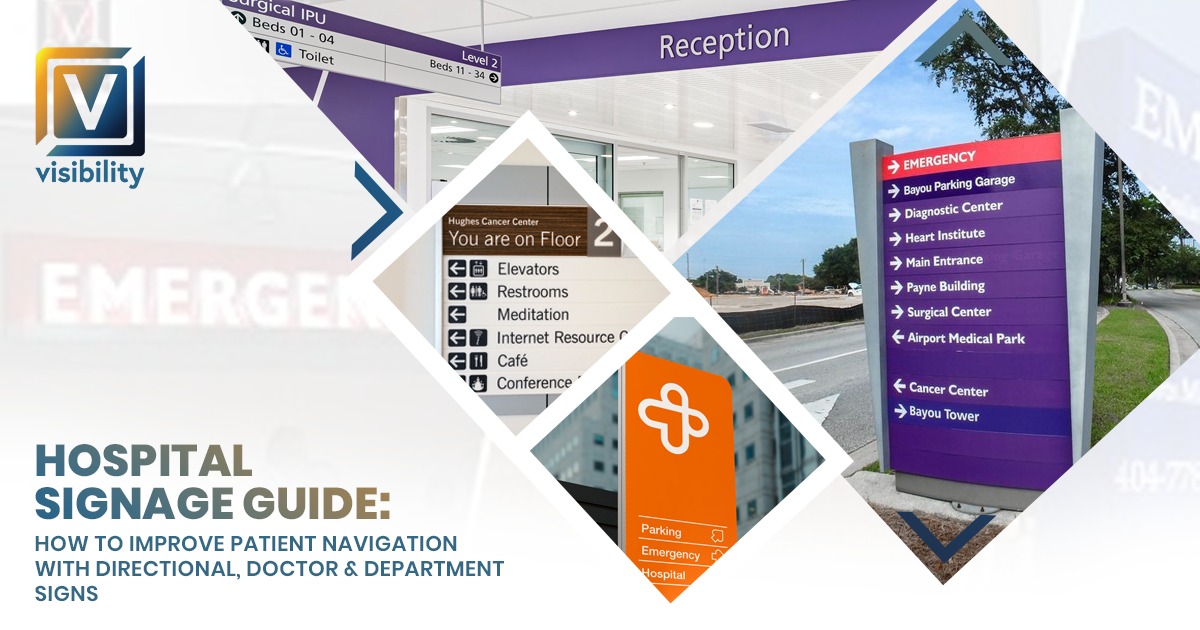
Before a patient even enters the building, they need to know where to go. Exterior hospital signage includes everything from road-facing monument signs that identify the facility to directional arrows guiding drivers to emergency entrances, outpatient clinics, visitor parking, and staff parking areas.
Large hospitals and medical campuses often have multiple buildings and entrances. Without clear exterior wayfinding, patients arriving for the first time will feel lost before they even walk through the door. This is especially critical for emergency situations where every second matters.
Key exterior signage types include:
- Monument signs at main road entrances identifying the hospital name and logo
- Parking directional signs with arrows for different zones — ER, visitor, valet, staff
- Building identification signs on each structure in a multi-building campus
- Emergency department signs with high-visibility illumination
- Accessible entrance and drop-off zone signs
2. Lobby and Reception Signage
The lobby is the first interior space every patient, visitor, and vendor enters. It sets the tone for the entire visit. Your lobby signage needs to immediately answer three questions: Where am I? Where do I need to go? How do I get there?
A well-designed lobby sign system includes a large, prominent hospital identification sign — typically dimensional letters or backlit channel letters — mounted prominently on the reception desk wall or main lobby wall. This anchors the space and confirms the patient is in the right building.
Directory signs in the lobby are equally essential. A floor-by-floor or department-by-department directory, either as a static printed panel or a digital display, allows patients to quickly identify which floor or wing houses the department they need before approaching reception.
- Reception desk signs with hospital branding and department name
- Lobby directory signs listing departments, floors, and room numbers
- Welcome signs and visitor policy signs
- Health and safety signage near entry points
3. Department Identification Signs
Each department within a hospital — cardiology, radiology, oncology, orthopedics, maternity, pharmacy, and more — needs clear, consistent identification signage. Department signs should be large enough to read from a distance, use the hospital’s brand colors and typography, and include the department name in plain language rather than medical jargon wherever possible.
For patients who are elderly, visually impaired, or experiencing health-related anxiety, clarity and legibility in department signage is not just helpful — it is a necessity. Consider using bold sans-serif fonts, high contrast color combinations, and pictogram icons alongside text to make department signs accessible to a wider range of patients.
Department signs typically appear:
- At corridor intersections leading to the department
- Above the main entrance to the department
- On walls directly outside waiting rooms and check-in desks
4. Doctor and Staff Nameplates
Doctor nameplates outside office and consultation room doors serve multiple purposes. They identify the physician or specialist inside, communicate credentials, and add a layer of professionalism and personalization to the clinical environment.
For patients, seeing a nameplate that reads “Dr. Sarah Johnson, MD — Cardiologist” immediately before entering a consultation room provides reassurance and confirms they are in the right place. For hospitals with multiple physicians sharing suites or rotating office spaces, modular nameplate systems allow easy updates when doctors change rooms or departments.
Best practices for doctor and staff nameplates include:
- Consistent size and material across all offices and consultation rooms
- Clear display of name, title, and specialty or department
- ADA-compliant braille and tactile elements for accessibility
- Modular or insert-style holders that allow for easy updates
5. Corridor Directional Signs and Floor Graphics
Long hospital corridors are one of the biggest sources of patient navigation frustration. Without consistent directional signage at regular intervals, patients quickly become disoriented in identical-looking hallways.
Corridor directional signs should appear at every intersection, elevator bank, and stairwell. They should use arrows, department names, and floor numbers together so that a patient can immediately understand which way to turn. Color coding by department or floor level is an extremely effective strategy in large hospitals — once a patient learns that blue means cardiology and green means oncology, they can follow colors even without reading every sign.
Floor graphics are another powerful but often overlooked wayfinding tool in hospitals. Adhesive floor graphics can create colored pathway lines that patients literally follow from the entrance to their destination. Hospitals that use floor pathway systems report significant reductions in patient confusion and staff interruptions.
6. Elevator and Stairwell Signs
Vertical movement between hospital floors is one of the most disorienting transitions for patients. Elevator lobby signs need to clearly indicate which elevator bank serves which floors or departments. Inside the elevator, floor-by-floor department listings allow patients to confirm their destination before stepping out.
Stairwell signs are equally important for staff movement and for patients in lower-acuity situations. Clear floor level identification and directional arrows within stairwells reduce the chance of someone exiting on the wrong floor.
7. Bathroom, Utility, and Service Signs
Bathroom signage in hospitals must meet ADA compliance standards, which require tactile braille elements, specific mounting heights, and color contrast requirements. Beyond compliance, hospital bathroom signs should be clearly visible from corridors and consistent in design with the rest of the signage system.
Utility and service doors — biomedical waste, pharmacy supply, staff-only areas — also need clear signage to prevent unauthorized access and guide maintenance and service staff efficiently.
8. Emergency and Safety Signs
No hospital signage system is complete without clearly positioned emergency and safety signs. These include fire exit signs, emergency assembly points, code blue response locations, defibrillator locations, fire extinguisher positions, and hazardous material handling zones.
Emergency signs are governed by specific codes and standards, but within those parameters, hospitals can still ensure that emergency signage integrates with their overall design language rather than appearing as an afterthought pasted over branded walls.
Design Principles for Effective Hospital Signage
The best hospital signage systems are built on a handful of core design principles that ensure consistency, legibility, and accessibility across every zone of the facility.
Consistency Across All Sign Types
Every sign in your hospital — from the exterior monument sign to a bathroom door placard — should belong to the same visual family. This means consistent use of your hospital’s brand colors, approved typefaces, logo placement, and icon style. When signage is consistent, patients subconsciously build confidence in the system and trust that every sign they see is reliable.
Legibility at Distance and in Motion
Hospital visitors are often moving quickly, stressed, or carrying items. Signs need to be readable at a glance from distances of ten feet or more. This means using appropriately large type sizes, high contrast between text and background, and avoiding decorative or overly stylized fonts that sacrifice readability for aesthetics.
ADA Compliance is Non-Negotiable
The Americans with Disabilities Act (ADA) has specific requirements for signs in healthcare facilities. This includes tactile characters and Grade 2 braille on room identification signs, specific mounting heights, non-glare finishes, and contrast ratios. Non-compliance exposes hospitals to legal liability and — more importantly — excludes visually impaired patients from accessing the navigation system.
Multilingual and Pictogram Support
In communities with significant non-English speaking populations, hospitals should consider incorporating multilingual text on key directional and department signs. Universal pictogram icons — a heart for cardiology, a baby for maternity, a cross for pharmacy — reduce language barriers and speed up navigation for all patients.
The ROI of Investing in Professional Hospital Signage
Some hospital administrators view signage as an operational cost rather than an investment. In reality, a well-executed hospital signage system delivers measurable returns across multiple areas of hospital performance.
- When patients can navigate independently, nurses and reception staff spend less time giving directions and more time on patient care.Reduced staff interruptions:
- Facilities with clear, professional signage consistently score higher on patient satisfaction surveys, which directly impact hospital reimbursement and public reputation.Higher patient satisfaction scores:
- Efficient navigation reduces appointment delays caused by patients arriving late at the wrong department.Faster patient flow:
- A hospital that looks organized and well-maintained builds trust with patients before any medical interaction even begins.Brand trust and perception:
- Proper ADA-compliant signage protects hospitals from accessibility-related legal challenges.Reduced liability:
How Visibility Signs & Graphics Serves Healthcare Facilities
At Visibility Signs & Graphics, we understand that hospitals are not like any other commercial client. Signage installations must happen without disrupting patient care. Materials must meet healthcare environment standards — non-porous, cleanable surfaces that resist bacteria and harsh cleaning chemicals. And every sign must reflect the trust and professionalism that patients expect from their healthcare provider.
We have extensive experience designing, manufacturing, and installing complete signage systems for hospitals, medical office buildings, outpatient clinics, surgical centers, and specialty care facilities across Utah and beyond.
Our hospital signage services include:
- Full wayfinding system design from exterior to every interior department
- ADA-compliant room identification and nameplate systems
- Doctor and staff nameplate systems with modular update capability
- Floor graphics and corridor pathway systems
- Department and lobby identification signage
- Emergency and safety sign integration
- Signage project management from concept through installation
We work with your facilities team, brand team, and compliance officers to ensure every sign meets your specifications, ADA requirements, and your hospital’s brand standards before a single sign is installed.
Also Read:
Planning an Office Renovation? Here’s How to Handle Glass Branding, Wall Graphics & Signage Together
Planning Your Hospital Signage Project: Where to Start
If your hospital is planning a new signage system, a renovation update, or an expansion that requires new wayfinding, the process begins with a comprehensive signage audit.
A signage audit evaluates every existing sign in the facility — what is working, what is outdated, what is missing, and what is non-compliant. From there, a complete signage plan is developed that maps every sign location, defines specifications for each sign type, and establishes a consistent visual system that carries through every zone of the hospital.
At Visibility Signs & Graphics, our project management team guides hospital clients through every stage:
- Discovery and audit of existing signage conditions
- Design development with your brand and compliance requirements
- Prototype review and approval before full production
- Phased manufacturing to coordinate with construction or renovation schedules
- Professional installation with minimal disruption to hospital operations
- Post-installation review and ongoing maintenance support
Frequently Asked Questions — Hospital Signage
Q: What types of signs does a hospital need for patient navigation?
A: A hospital needs a complete wayfinding system that includes exterior directional signs, parking signs, lobby directory signs, department identification signs, corridor directional signs, elevator signs, doctor nameplates, bathroom signs, and emergency exit signs. Together, these guide patients from the parking lot to the exact room they need without confusion.
Q: Are hospital signs required to be ADA compliant?
A: Yes. The Americans with Disabilities Act (ADA) requires that room identification signs in healthcare facilities include tactile raised characters and Grade 2 braille, meet specific mounting height requirements, and maintain proper color contrast ratios. Non-compliant signage can expose a hospital to legal liability and also excludes visually impaired patients from using the navigation system.
Q: How do department signs help reduce staff interruptions?
A: When patients can read clear, well-placed department signs throughout the facility, they can navigate independently without asking nurses or reception staff for directions. This frees up clinical staff to focus on patient care rather than giving directions, which is especially valuable in busy hospitals where staff time is limited.
Q: What materials are best for hospital signage?
A: Hospital signs should be made from materials that can withstand frequent cleaning with hospital-grade disinfectants. Non-porous surfaces like brushed aluminum, acrylic, and PVC foam boards are popular choices. These materials are durable, easy to clean, resistant to bacteria buildup, and can be produced in any color or finish to match your hospital’s brand.
Q: Can doctor nameplates be updated easily when staff changes?
A: Yes. Modular nameplate systems use replaceable insert holders that allow you to swap out individual name panels without replacing the entire sign frame. This is ideal for hospitals where physicians rotate between rooms or departments, or when new staff join the team. It saves both time and cost compared to ordering entirely new signs.
Q: What is the benefit of using floor graphics in a hospital?
A: Floor graphics create colored pathway lines that patients can physically follow from the entrance to their destination. Studies in healthcare wayfinding show that floor pathway systems significantly reduce patient confusion in long corridors, lower the number of wrong turns, and create a calmer navigation experience — especially for first-time visitors or elderly patients.
Q: How long does it take to install a complete hospital signage system?
A: The timeline depends on the size of the facility and the scope of the project. For a mid-size hospital, a full signage system from design through installation typically takes 8 to 16 weeks. This includes the audit, design development, client approval, manufacturing, and phased installation scheduled to avoid disruption to hospital operations. Visibility Signs & Graphics provides detailed project timelines during the consultation phase.
Q: Can signage help improve patient satisfaction scores?
A: Absolutely. Patient satisfaction surveys consistently show that clear navigation, a professional environment, and an organized facility contribute to higher scores — even before any medical treatment begins. Patients who feel lost or confused report lower satisfaction regardless of the quality of care they receive. Effective signage is a direct investment in how patients experience your hospital.
Q: Does Visibility Signs & Graphics work with hospitals outside Utah?
A: Yes. While our primary locations serve Provo, Salt Lake City, West Valley City, Clearfield, and Park City, Visibility Signs & Graphics works with healthcare clients on larger projects beyond Utah. Contact our team to discuss your facility’s location and project scope.
Q: How do I get started with a hospital signage project?
A: The first step is a consultation with our team. We will review your facility, assess your current signage conditions, discuss your brand standards and compliance requirements, and put together a custom plan and quote. You can call us at (801) 212-9987 or visit visibilitysign.com to request a consultation.
Also Read:
Office Makeover Checklist: Everything You Need From Entrance Signs to Indoor Directional Signage
Conclusion
Hospital signage is one of the most impactful investments a healthcare facility can make. It shapes the first impression every patient and visitor forms, guides them through a complex environment, communicates professionalism and care, and reduces the operational burden on your clinical staff.
From exterior monument signs and parking directional signs to lobby directories, department identifiers, doctor nameplates, and corridor wayfinding graphics — every sign in your hospital is an opportunity to serve your patients better.
Visibility Signs & Graphics specializes in complete hospital signage systems designed to perform beautifully, comply fully, and last for years. If your facility is ready to elevate the patient navigation experience, we are ready to help.
Back